



NPRA Banner

               
Product Search   QUEST3+ System   Enquiries   Sitemap  

User Rating: 5 / 5

Star ActiveStar ActiveStar ActiveStar ActiveStar Active

2025

Efficacy of Fetal Wharton’s Jelly Mesenchymal Stem Cells-Derived Small Extracellular Vesicles in Metabolic Syndrome

Biomolecules 2025; 15(1):44

Quality Control of Fetal Wharton's Jelly Mesenchymal Stem Cells-Derived Small Extracellular Vesicles

Int J Nanomedicine 2025;20:1807-1820

Precision Medicine in Oncology: Imatinib Dosing in the Obese Cancer Population Using Virtual Clinical Trials

CPT Pharmacometrics Syst Pharmacol 2025; 14(6):1050-1064

Assessing the Malaysian Regulatory Process for Medicinal Product Approval: An OpERA Methodology and Standardized Reporting Approach

Ther Innov Regul Sci (2025)

GC–MS method for routine analysis of camphor, menthol, methyl salicylate, and thymol in traditional topical products: Addressing compliance and adulteration from Malaysia's National Pharmaceutical Regulatory Agency

Results in Chemistry 2025; 18: 102721

Safety Evaluation and Biodistribution of Fetal Umbilical Cord Mesenchymal Stem Cells-Derived Small Extracellular Vesicles in Sprague Dawley Rats

Int J Mol Sci 2025;26(14):6806

Clinical pharmacokinetics and pharmacometabolomics of Andrographis paniculata capsules: Bridging drug disposition and metabolic response to precision medicine

Naunyn Schmiedebergs Arch Pharmacol 2025

Evaluation of the antiproliferative effect of Zingiber zerumbet essential oil against oral squamous cell carcinoma

S Afr J Bot 2025; 187: 337-350


2024

Use of biosimilars: A systematic review of published position statements and recommendations from health organisations and societies.

BioDrugs 2024

Data-Driven Identification of Factors That Influence the Quality of Adverse Event Reports: 15-Year Interpretable Machine Learning and Time-Series Analyses of VigiBase and QUEST.

JMIR Med Inform 2024;12:e49643

LL37 Microspheres Loaded on Activated Carbon-chitosan Hydrogel: Anti-bacterial and Anti-toxin Wound Dressing for Chronic Wound Infections

AAPS PharmSciTech 2024;25, Article number:110

Repurposing cardiac glycosides for anticancer treatment: a review of clinical studies.

Drug Discov Today 2024:104129

Strategies to enhance risk communication about medicines in Malaysia: a Delphi study among multinational experts

BMC Health Services Research 2024;24, Article number:1019

12th National Pharmacy R&D Conference 2024 abstracts

Pharmacy Research Reports Volume 7 Supplement Issue August 2024

Unlocking Natural Potential: Antibody-Drug Conjugates With Naturally Derived Payloads for Cancer Therapy

Phytotherapy Research 2024


2023

Determination of ethanol, isopropyl alcohol and methanol in alcohol-based hand sanitiser to ensure product quality, safety and efficacy.

Scientific Report 2023; 13, Article Number: 9478

Carbamazepine‐induced Severe Cutaneous Adverse Drug Reactions: A 21‐year comparison between children and adults in Malaysia

Clinical Pharmacology 2023; 63(10): 1126-1132 

Hearing loss and tinnitus associated with COVID-19 vaccines: An analysis from the national pharmacovigilance database in Malaysia.

Asian Pacific Journal of Tropical Medicine 2023; 16(7): 289-295

Thrombocytopenia and venous thromboembolic events after BNT162b2, CoronaVac, ChAdOx1 vaccines and SARS-CoV-2 infection: a self-controlled case series study

Scientific Reports 2023; 13, Article Number: 20471 

Regulatory Oversight of Cell and Gene Therapy Products in Malaysia.

In: Galli, M.C. (eds) Regulatory Aspects of Gene Therapy and Cell Therapy Products. Advances in Experimental Medicine and Biology, vol 1430. Springer, Cham.

National Regulatory Conference 2023 poster abstracts.

Pharmacy Research Reports Volume 6 Supplement Issue November 2023


2022

Pharmacokinetic–Pharmacometabolomic Approach in Early-Phase Clinical Trials: A Way Forward for Targeted Therapy in Type 2 Diabetes. 

Pharmaceutics 2022; 14: 1268.

Pharmacokinetics and Metabolomic Profiling of Metformin and Andrographis paniculata: A Protocol for a Crossover Randomised Controlled Trial. 

J. Clin. Med. 2022; 11: 3931.

Incidence of Antiseizure Medication–Induced Severe Cutaneous Adverse Reactions in Malaysia. 

The Journal of Clinical Pharmacology 2022, 62(8): 983-991

Incidence of allopurinol-induced severe cutaneous adverse drug reaction in Malaysia.

British Journal of Clinical Pharmacology 2022, 88(8): 3782-3788

Risk of serious adverse events after the BNT162b2, CoronaVac, and ChAdOx1 vaccines in Malaysia:

A self-controlled case series study.

Vaccine 2022; 40 (32): 4394-4402


2021

Cell and gene therapy products in Malaysia: a snapshot of the industry's current regulation preparedness Cytotherapy 2021 Dec;23(12):1108-1113

Allopurinol-Induced Severe Cutaneous Adverse Drug Reactions: An Analysis of Spontaneous Reports in Malaysia (2000-2018)

Ther Innov Regul Sci.; 55(3):514-522.


2020

Allopurinol-induced severe cutaneous adverse drug reactions: Risk minimisation measures in Malaysia.

Pharmacoepidemiol Drug Saf.; 29(10): 1254– 1262. 

An Evaluation of Malaysian Regulatory Process for New Active Substances Approved in 2017 Using the OpERA Methodology. 

Therapeutic Innovation & Regulatory Science; 54: 1215–1224


2019

Unique product quality consideration in vaccine development, registration and new program implementation in Malaysia,

Human Vaccines & Immunotherapeutics; 16(3): 530-538

Enhancing Post-market Surveillance Through Laboratory Testing on Blue-green Algae Products in Malaysia. 

International Journal Of Biomedical And Clinical Sciences; 4(3): 82-90.


2017

Phosphodiesterase-5 inhibitors and their analogues as adulterants of herbal and food products: analysis of the Malaysian market, 2014–16,

Food Additives & Contaminants: Part A; 34(7): 1101-1109

An Update on the Registration of Biosimilars in Malaysia.

Therapeutic Innovation & Regulatory Science; 51(1): 55-59. 

A qualitative study among potential manufacturers on the development of ‘Made in Malaysia’ biological products: Challenges and proposed solutions. 

Journal of Commercial Biotechnology; 23(4): 44-61. 


User Rating: 2 / 5

Star ActiveStar ActiveStar InactiveStar InactiveStar Inactive

HISTORY

The National Pharmaceutical Regulatory Agency (NPRA), formerly known as the National Pharmaceutical Control Bureau (NPCB), was set up in October 1978 under the quality control activity of Pharmacy and Supply Programme. This institution was established to implement quality control on pharmaceutical products. The infrastructure and facilities were designed to meet the requirements for testing and quality control activities.

Beginning 1985, NPRA was given the task of ensuring the quality, efficacy and safety of pharmaceuticals through the registration and licensing scheme. This is achieved through evaluation of scientific data and laboratory tests on all products before they are marketed. A system to monitor products in the market was set-up. Information on drugs for medical professionals and consumers was made available through a drug information service.

The NPRA also handles courses and provides training to drug regulatory personnel from the other countries, for example from Sri Lanka, Bangladesh, Myanmar, Mongolia and Vietnam.

In 1996, NPRA was given an international recognition by the World Health Organisation (WHO) as a "WHO Collaborating Centre for Regulatory Control of Pharmaceuticals". This recognition is an acknowledgement from WHO for NPRA's contribution in the field of regulatory affairs.


VISION

Enhancing our nation’s health through excellence in the practice of pharmacy.


MISSION

i. Uphold legislation and improve policies to ensure the quality of pharmaceutical products and services. 

ii. Ensure effective and responsive organisational system towards sustainable quality services.

iii. Build capabilities and professionalism through talent development and workforce empowerment.

iv. Intensify collaboration towards best practices and standards.

v. To safeguard the nation’s health through scientific excellence in the regulatory control of medicinal products and cosmetics. 


OBJECTIVE

To ensure that therapeutic substances approved for the local market are safe, effective and of quality and also to ensure that notified cosmetic products are safe and of quality.

User Rating: 4 / 5

Star ActiveStar ActiveStar ActiveStar ActiveStar Inactive

The members of MADRAC (Malaysian Adverse Drug Reactions Advisory Committee) are selected based on their qualifications and expertise with regard to their respective fields of practice. They serve on the Committee for a renewable period of three years.


MADRAC Members Session 2025 - 2027
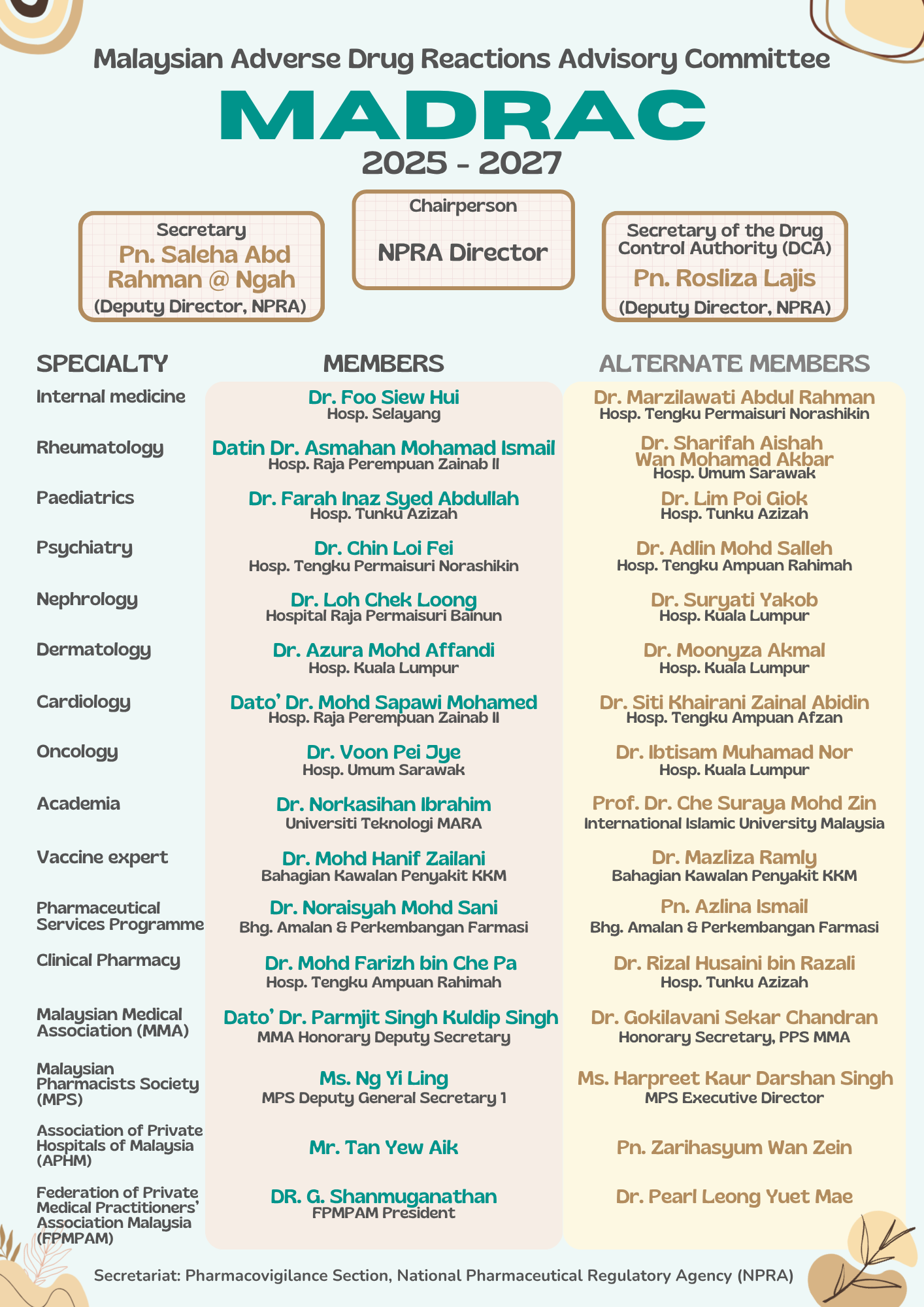
 

MADRAC-2025-2027-V4


NOMINATION CRITERIA FOR THE MADRAC MEMBERS


1.      MADRAC shall consist of the following members:


1.1      Three (3) members in their ex-officio capacity:

a)      Director of National Pharmaceutical Regulatory Agency (NPRA) - Chairperson

b)      Secretary of DCA, NPRA

c)      Deputy Director Centre for Compliance and Quality Control, NPRA - Secretary

1.2      Sixteen (16) members appointed by the Director General of Health.


2.      Criteria for nominating the MADRAC members are as follows:


2.1      Consultant Specialists/ Senior Consultant Specialists from MOH nominated by the respective heads of services/departments:

                          i.    2 consultant physicians

                         ii.    1 consultant dermatologist

                        iii.    1 consultant rheumatologist

                        iv.    1 consultant psychiatrist

                         v.    1 consultant nephrologist

                        vi.    1 consultant pediatrician

                       vii.    1 consultant oncologist

                      viii.    1 consultant with expertise in vaccines

                        ix.    1 pharmacist from the Pharmaceutical Services Programme

                         x.    1 pharmacist from a public health facility (hospital/health clinic)


a)  Must have at least 2 years of service with MOH remaining;

b)  Not among the members/alternate members of DCA


2.2      A pharmacist from a Public Institution of Higher Learning, and nominations will be requested from universities with teaching hospitals

a)  Must have at least 2 years of service with the Ministry of Higher Education remaining;

b)  Not among the members/alternate members of DCA


2.3      Representative from the private healthcare sector

i.    1 member of the Malaysian Pharmaceutical Society (MPS)

ii.   1 member of the Association of Private Hospitals Malaysia (APHM)

iii.  1 member from the Malaysian Medical Association (MMA)

iv.  1 member from the Federation of Private Medical Practitioner’s Association, Malaysia (FPMPAM)


a)  Must possess relevant professional qualifications (doctor or pharmacist) and experience;

b)  Must have retired from the Public Service


3.      Alternate members:

       In respect of appointed members, an alternate member shall be similarly qualified as the substantive member and appointed by the Director General of Health, Malaysia.


4.      All members of MADRAC are appointed by the Director General of Health for a term of 3 years.


If you have any queries regarding the appointment of MADRAC members, please contact the NPRA Pharmacovigilance Section at email: This email address is being protected from spambots. You need JavaScript enabled to view it.

Last updated: 30 Apr 2025 


National Pharmaceutical Regulatory Agency (NPRA)

Lot 36, Jalan Universiti (Jalan Prof Diraja Ungku Aziz), 46200 Petaling Jaya, Selangor, Malaysia.

  • Phone: +603-7883 5400


DISCLAIMER

The Government of Malaysia and the National Pharmaceutical Regulatory Agency are not responsible for any loss or damage caused by the usage of any information obtained from this website.

Site Last Modified

  • Last Modified: Wednesday 17 December 2025, 10:07:11.
© Copyright 2024 . All Rights Reserved National Pharmaceutical Regulatory Agency NPRA Site Map

Search

Main Menu English